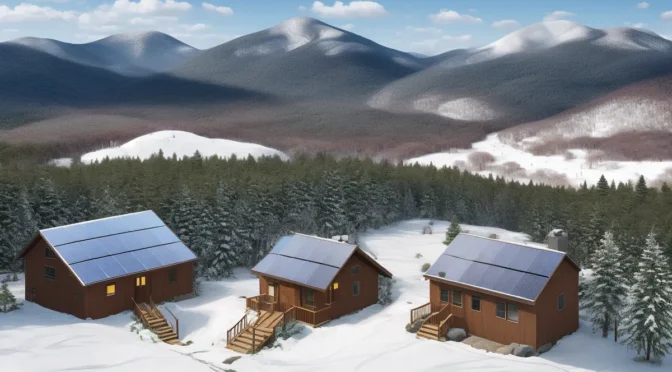
If you’re building a Meshtastic node meant to run outdoors year-round without shore power, your hardware choices matter enormously. This guide covers the best Meshtastic solar node builds for 2026 — ranked by power efficiency, cold-weather resilience, and real-world reliability in challenging terrain like the Adirondacks.
Unlike affiliate-style roundups, these picks are grounded in actual field behavior. A node that looks great on a summer bench test can fail in November if you haven’t sized the solar panel for shoulder-season insolation or chosen a battery chemistry that handles sub-zero temperatures.
What Makes a Great Meshtastic Solar Node?
Three factors drive solar node success:
- Average current draw — not peak TX current, but the milliamps consumed 24 hours a day across sleep, idle, and transmit cycles
- Battery chemistry and capacity — LiFePO4 wins for cold climates; standard Li-Ion loses 25–40% capacity below -10°C and cannot be safely charged below freezing
- Panel sizing for worst-month insolation — size for December sun hours, not July. A panel that works great in summer can leave your node dark all winter
The Adirondacks see roughly 2.0–2.5 peak sun hours (PSH) per day in December and January. A node drawing 5 mA average needs ~120 mAh/day from the panel — achievable with a 1W panel in summer, but you need a 3–5W panel to handle winter cloudy stretches with margin to spare.
Best Hardware for Meshtastic Solar Nodes in 2026
1. RAK WisBlock RAK4631 — Best for Unattended Long-Term Deployment
The RAK4631 paired with a RAK19003 Mini Base Board remains the gold standard for low-power unattended solar nodes in 2026. Built on the Nordic nRF52840, the module achieves ~100 µA sleep current with the LoRa radio in standby — a fraction of what ESP32-based boards consume at rest.
Key specs:
- Sleep current: ~100 µA (measured)
- TX peak current: ~130 mA at full output
- Average draw at 15-min TX interval: ~2–4 mA typical
- Operating temperature: -40°C to +85°C (nRF52840 rated)
- LoRa chip: SX1262
- Approximate cost: $35–50 (module + base board)
Best solar pairing: A 3.7V LiFePO4 cell (3000–6000 mAh), a 2W–4W panel, and the CN3791 MPPT charger module. This combination can realistically deliver 18–24 months of unattended operation with only annual maintenance visits.
Adirondack note: The nRF52840 remains reliable well below -20°C. Do not use standard Li-Ion cells in outdoor unheated enclosures in northern New York — LiFePO4 is mandatory for any year-round build.
2. LILYGO T-Beam Supreme — Best for GPS Position-Reporting Nodes
If your node serves a dual role as a position-reporting tracker or a relay with precise location metadata, the LILYGO T-Beam Supreme is the standout 2026 option. It ships with an AXP2101 power management IC — a meaningful improvement over the earlier AXP192 found in older T-Beam variants, offering lower quiescent current and better battery charge management including solar input support.
Key specs:
- MCU: ESP32-S3 dual-core
- LoRa: SX1262
- GPS: u-blox M10 (low-power GNSS)
- Sleep current: ~1.5–2 mA with GPS off
- Battery: 18650 cell holder (included)
- Approximate cost: $40–50
Best solar pairing: A quality 18650 LiFePO4 cell (EVE or Lishen brand), a 6W–10W panel to cover the higher baseline draw, and an IP65-rated ABS junction box. Disable GPS when accurate position is not needed — the u-blox M10 adds ~25 mA while actively acquiring satellites.
3. Heltec WiFi LoRa 32 v3 — Best Budget Build for Accessible Locations
The Heltec v3 (ESP32-S3 + SX1262) is the most widely deployed Meshtastic board in 2026. It is inexpensive (~$20), ships with a built-in OLED display for local status readout, and Meshtastic firmware support is mature and well-tested. Its higher sleep current (~800 µA to 1.5 mA depending on firmware and sleep configuration) makes it less ideal for deep-winter unattended deployments, but for accessible nodes that receive seasonal maintenance it represents excellent value.
Key specs:
- Sleep current: ~800 µA–1.5 mA
- TX peak: ~120 mA
- Average current at 15-min TX interval: ~5–8 mA
- Built-in OLED: 128×64 pixels
- Approximate cost: $20–25
Best solar pairing: A 5W panel minimum, a 6000–10000 mAh LiFePO4 pack, and a DFRobot Solar Power Manager (DFR0559) for clean MPPT charging. The Heltec is a strong choice for trail junction nodes that someone hikes to a few times per year to check battery health.
4. Seeed XIAO nRF52840 + SX1262 LoRa — Best Compact Form Factor
For builds where enclosure size is the primary constraint — narrow pole mounts, fence posts, or tight urban installations — the Seeed XIAO nRF52840 paired with the WIO-SX1262 LoRa module delivers WisBlock-class power consumption in a dramatically smaller package. The XIAO form factor is 21mm × 17.5mm, enabling extremely tight custom enclosure designs.
Key specs:
- Deep sleep current: ~5 µA
- Platform: Nordic nRF52840 (same MCU as RAK4631)
- LoRa: SX1262 (SPI connected)
- Approximate cost: ~$10 XIAO + ~$15 LoRa module = ~$25 total
This is a more involved DIY build requiring soldering and custom case design, but for experienced builders it is the most power-efficient and compact option available at any price point in 2026.
Solar Panel Sizing for Northern Climates
Panel sizing is where most solar node builds go wrong. The near-universal mistake is sizing for summer peak output. Use this planning approach instead:
Sizing formula: Daily energy need (mAh) ÷ worst-month PSH ÷ system efficiency (~0.75) = minimum panel current at STC
Worked example — WisBlock node at 3 mA average current:
- Daily energy need: 3 mA × 24 h = 72 mAh
- Required panel output: 72 ÷ 2.0 PSH ÷ 0.75 = 48 mA minimum from panel
- A 1W / 6V panel delivers ~166 mA at STC — meets minimum, but add 2× safety margin
- Final recommendation: 2W–3W panel for winter safety margin and snow/soiling losses
Snow accumulation on a flat-mounted panel is a real factor in northern NY. Angling your panel at 60–70° from horizontal sheds snow better and captures low winter sun at a better angle — both arguments for a steeper panel mount in the Adirondacks.
Battery Chemistry: LiFePO4 vs Li-Ion for Outdoor Nodes
| Property | LiFePO4 | Li-Ion / LiPo |
|---|---|---|
| Usable temperature range | Discharge: -20°C to +60°C Charge: 0°C to +45°C |
Discharge: -20°C to +60°C Charge: 0°C to +45°C (severe capacity loss below 0°C) |
| Cycle life | 2000–3000+ cycles at 80% DoD | 300–500 cycles |
| Nominal voltage | 3.2V per cell | 3.6–3.7V per cell |
| Safety | Very thermally stable — no thermal runaway risk | Requires protection circuit; thermal runaway possible |
| Cold-weather capacity | Retains ~85% capacity at -10°C | Retains ~60–70% capacity at -10°C |
For unattended outdoor nodes in northern climates: LiFePO4 is the only responsible choice. Li-Ion capacity drops significantly at -10°C and charging below 0°C causes lithium plating that permanently damages cells. If you’re using a generic solar power bank as your battery — it almost certainly contains Li-Ion cells and will underperform or fail in an Adirondack winter.
Enclosures and Weatherproofing
The enclosure is the most underrated component in a solar node build. Common failure modes observed in field deployments:
- Condensation inside the box from daily thermal cycling — add a fresh silica gel desiccant packet and replace it annually
- Water ingress at antenna feedthrough — use proper M16 or M20 nylon cable glands with a rubber seal, not electrical tape around the coax
- UV degradation of PLA or standard ABS printed cases — use ASA or PETG filament for printed enclosures, or buy commercial ABS/polycarbonate rated for outdoor use
- Antenna connector corrosion at the board — use self-amalgamating tape over the SMA connector and pigtail exit point
Recommended commercial enclosures:
- Polycase WC-18 or WC-22 (ABS, IP65-rated, ~$12–18) — good value for most builds
- Hammond 1554 series (polycarbonate, IP66) — better long-term UV resistance and clarity
- Generic IP67 ABS junction boxes for budget builds — verify actual IP rating before relying on it
Antenna Selection for Fixed Solar Nodes
For a fixed solar repeater, the antenna choice has an outsized impact on coverage. Key considerations:
- Frequency: 915 MHz for US/Canada — verify your board’s region lock before deploying. European SX1262 boards are often pre-configured for 868 MHz
- Fiberglass whip antennas (2–5 dBi) substantially outperform rubber duck antennas for fixed nodes; the investment is worth it for any permanent deployment
- Coax quality matters: Use RG-316 or LMR-195 for runs under 3 m; LMR-400 for longer exterior runs. Every meter of lossy coax reduces effective range
- Mounting height: Every doubling of antenna height over flat terrain roughly doubles the radio horizon. A node at 6 m AGL versus 1.5 m AGL can more than double effective mesh coverage in open terrain
If you want a concrete outdoor antenna example for this class of build, the Alfa AOA-915-5ACM from Rokland is a practical fixed-node option for the 915 MHz setups discussed here.
Pre-Deployment Checklist
- Bench test 72+ hours with current logging — verify sleep current with a Nordic PPK2, an Otii Arc, or a simple INA219 breakout
- Confirm charge controller is operating correctly — measure panel Voc, verify battery voltage at end of a full sun day
- Inspect all cable gland seals and tighten securely; verify antenna pigtail connection at board and at antenna base
- Add fresh silica gel desiccant packet, seal enclosure
- Record: firmware version, channel config, encryption PSK, GPS coordinates of installation point
- Log baseline battery voltage at dawn and dusk for the first 7 days
- Create a maintenance schedule — every 6 months is recommended for northern Adirondack deployments
Choosing the Right Build for Your Site
There is no single best Meshtastic solar node — the right hardware depends on your site access, maintenance cadence, and network coverage goals:
- Deep woods / infrequent access / year-round: RAK4631 + LiFePO4 + 3W panel. For a turnkey equivalent with an external 5W panel and rugged IP67 housing, see our Atlavox Beacon assessment.
- Accessible trail junction / seasonal maintenance acceptable: Heltec v3 + LiFePO4 pack + 5W panel. Or, if you want no-assembly with pre-flashed Meshtastic, the WisMesh Repeater Mini covers the same use case at $99.97.
- GPS position-reporting relay node: T-Beam Supreme + LiFePO4 18650 + 6W panel
- Compact pole or fence-post mount: XIAO nRF52840 + SX1262 + 2W panel
If you’re building nodes to expand coverage in the Adirondacks, ADKMesh maintains a growing regional mesh network. Coordinating your deployment with the existing node map prevents coverage overlap and maximizes mesh value for everyone on the network.
Further Reading
- Atlavox Beacon Solar Meshtastic Node: An Assessment for Adirondack Deployment
- WisMesh Repeater Mini: Cheap Coverage-Gap Filler for Adirondack Mesh Deployments
- Meshtastic Beginner Setup (US 915 MHz)
- Meshtastic Official Hardware Documentation
- Meshtastic Power Configuration Guide
- Meshtastic Radio Settings Overview
- Meshtastic Alternatives in 2026: Practical Comparison by Use Case
- Adirondack Node Deployment Guide: legal, ethical, and field deployment checklist
- Welcome to ADKMesh
FAQ: Meshtastic Solar Node Builds in 2026
What battery chemistry is best for outdoor Meshtastic solar nodes?
LiFePO4 is the strongest choice for year-round outdoor use because it is safer, longer-lasting, and more resilient in cold conditions than typical Li-Ion packs.
How large should a solar panel be for a Meshtastic node in winter?
In northern climates, a practical starting point is usually 2W to 5W depending on average current draw and site shading. Size for worst-month sun, not summer peak output.
What is the most reliable low-power board for unattended deployments?
RAK WisBlock-based builds are commonly preferred for low average draw and long unattended runtime when paired with a correctly sized panel and LiFePO4 battery.
Can I use a standard USB solar power bank as a node battery?
For year-round outdoor use, that is usually a poor choice. Many power banks use Li-Ion cells and control circuits that underperform in sustained cold weather.
Join ADKMesh
Want to run a node or host a relay location in the Adirondacks?